Life in the middle.
Thursday provisions, Saturday stalls, and the short covered arcade. June has the records out. Rowan’s glass catches the nursery window.
AN ENGLISH TOWN. ROOM FOR COMPANY.
Welcome to Bellweather. A bend in the river, a market full of stories, and a little room for company.
The home of Sir Geoffrey
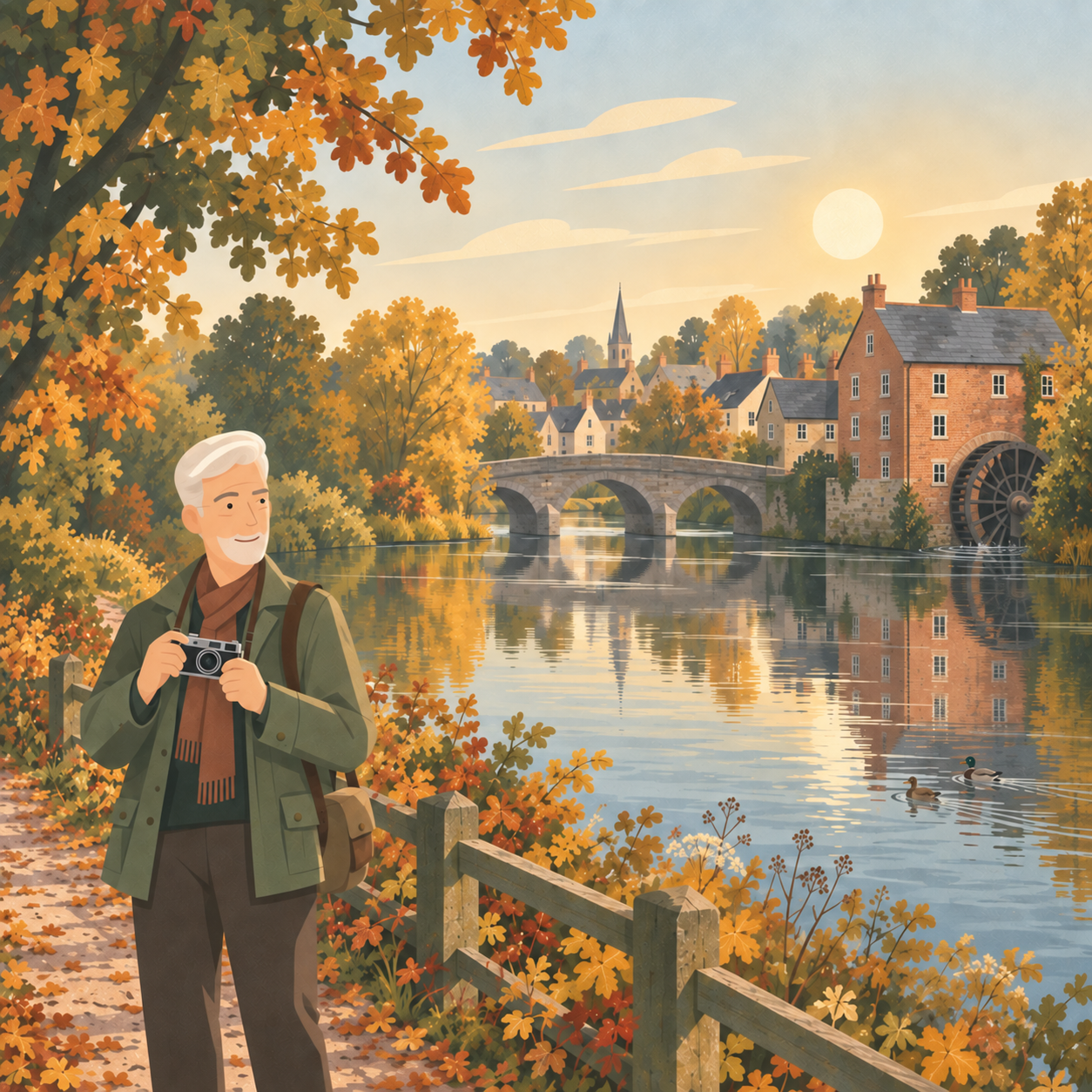
WELCOME TO BELLWEATHER
Bellweather grew around a crossing. Farms brought trade, trade brought neighbours, and neighbours eventually needed somewhere dry to disagree.
The market, the mill and the narrow streets still shape the place. So do the people who keep its gardens growing, its books circulating, and its chairs available.
You are very welcome to look around.
TWO MINUTES ABOVE & THROUGH TOWN
Fly down into Market Place, pass through the arcade and garden lanes, then follow the town towards the River Mere. Return to the square for a warm welcome from Sir Geoffrey.
“A little beauty,
and room for company.”
A two-minute animated flythrough · Original score & spoken welcome
Hear Sir Geoffrey’s town history in the audio feature below.
1,242 views
THE STORY, IN GOOD COMPANY
Sir Geoffrey tells the longer story: how a crossing became a town, how its work changed, his schoolhouse and college years, the Saturday market, and the illustrated map that brings it all together.
Ah. There you are. I'm Sir Geoffrey. Come for a walk through Bellweather's history. We are in northern Gloucestershire, where the lower Cotswold slopes meet the Severn Vale. A useful place for a town, provided you don't mind a little mud.
Begin at the River Mere. Around eleven fifty, farms and trading journeys gathered at its shallow crossing. The name first appears as Bellwether in eleven eighty-six, after the bell-wearing sheep that led a flock. Bellweather, with an a, became the usual spelling during the seventeenth century. Even a town is entitled to adjust its stationery.
A market grant followed in twelve sixty-eight. The earliest stalls gathered on Mondays. Thursday became market day in eighteen fifty-one. People have presumably been standing in the way of deliveries ever since.
Look behind the narrow shop fronts. The long plots took shape during the later Middle Ages. Their buildings were divided, repaired, and given new faces. Bellweather was assembled by people who needed somewhere to work and live. Nobody seems to have consulted a postcard designer.
St Anne's began with a small chapel around eleven ninety. The church was rebuilt in fourteen twelve, and the spire arrived in eighteen twenty-seven. The hall beside it is much younger, opening in nineteen fifty-six. Old places are often several ages at once.
Thomas Hales built the main mill in seventeen forty-two. His daughter Anne later ran it, and the Mercer partnership took over in eighteen sixty-seven. Grain came from the farms, and the river did useful work. Milling ended in nineteen sixty-three. The Old Mill Rooms opened in nineteen ninety-eight, giving the building another life.
The stone bridge dates from eighteen eighteen; the Town Hall from eighteen fifty-six. Victor, our historian, once mistook its nineteen twenty-four repair campaign for its birthday. We caught that one before the invitations went out.
The arcade opened in eighteen eighty-seven. June's record counter arrived more than a century later, followed by Rowan's framing and Ellis's workshop. I find that reassuring. A place can be old without refusing anything new.
In the market square, the three-tier fountain sits among the geometric paving. Local contributions paid for it, and later hands kept it working. The little plaque tells the town's beginnings, not the fountain's age. The pigeons are less concerned with chronology. A little seed brings out what I call the breakfast delegation, while Lula waits beside me on her lead. One particularly round pigeon appears to be management.
The smaller Saturday produce and craft stalls became a regular arrangement in two thousand and two. They complement Thursday’s provision market. Different baskets, familiar faces, and the same remarkable ability to turn a five-minute errand into an entire morning. The fountain provides a meeting place. The pigeons provide supervision.
Beside Market Place stands the old schoolhouse, opened in eighteen forty-eight and enlarged in eighteen ninety-four. Agnes Wren taught there long before her bequest helped establish the library. I attended from nineteen eighty to nineteen eighty-six. Mrs Pritchard once caught me advancing the classroom clock four minutes. She made me spend seven explaining how it worked. Teaching moved to a new building in nineteen ninety-six, and the old rooms reopened for community use in two thousand and one. I leave the bell alone now.
The public library opened in nineteen-oh-seven, helped by a bequest from schoolmistress Agnes Wren. During the wars, the town knew absence and shortages. Mabel Turner organised food preserving; Arthur Baines helped supplies reach the outlying households. Those are stories passed down, not things I witnessed.
I was born here in nineteen seventy-five, and started at Bracken and Sons in nineteen ninety-two. From September nineteen ninety-three to July nineteen ninety-five, Edith Bracken arranged a day each week for me at Gloucestershire Research Institute. Horticulture, with landscape management and environmental history catching my interest. The photography club’s darkroom caught rather more of my evenings. Our unofficial mascot was a drawn snail in a mortarboard: the Dean of Damp. Finally, an academic who understood my pace.
I left for gardening work elsewhere in nineteen ninety-eight, and came home in twenty thirteen, the year I turned thirty-eight. The community garden had opened in twenty-oh-four. It had work that needed doing, and room for another pair of hands. The rather unfortunate knighthood followed in twenty fourteen. Cardboard crown. Wooden plant label. No palace involved.
We shall finish at the Rook and Lantern. Eliza Rook opened it in seventeen sixty-nine, with her rook emblem and a lantern for late arrivals. Bess has run it since twenty-oh-eight. Len's favourite chair is still not reserved.
Before you go, have a look at our illustrated map. It joined the town’s archive in twenty twenty-six. The paper looks aged; the picture is new. Rowan prepares a display copy, and I insist we label it honestly. The map younger than the tea, we call it. A portrait of the places we care about, not a survey. Please don’t use it to settle a boundary dispute. Bess has enough arguments in the pub already.
That's Bellweather. Nearly nine centuries of crossing, trading, growing, repairing, and making room. These days, Lula and I take our place in the continuing story. Do come back. I'll put the kettle on.
Town history · AI-generated voice
THE LONGER VIEW
20 chapters, from the first crossing to the town of today. From its twelfth-century beginnings to 2026, with Sir Geoffrey’s own story beginning in 1975.
Download the illustrated e-book (PDF) ↓
20 chapters · 34 pages · Original map & illustrations · © 2026 SG Bellweather, LLC
Bellweather stands in countryside in northern Gloucestershire, where the lower Cotswold slopes meet the Severn Vale. Its River Mere is a small tributary in the Severn catchment, flowing north-west to south-east through the town before turning towards the wider vale. The town centre occupies a dry shelf above the river; St Anne’s rises behind it, while West Meadow lies beyond the western bridge approach. In 2026, about 4,860 people live in the town and its immediate parish.
The settlement’s earliest working landscape consists of scattered farms, meadow grazing and a shallow crossing. The Mere, local boundaries and population belong to the town’s illustrated map.
Bellweather begins as a small crossing settlement around 1150. Its first written appearance in the town record is Bellwether in 1186, associated with sheep brought along the farm tracks towards the ford. The name refers to the bell-wearing lead wether of a flock; Bellweather becomes the usual local spelling during the seventeenth century. In 1268, a grant in Henry III’s reign establishes a weekly market and an autumn fair.
The original market gathers on Mondays. The town adopts Thursday as its principal provision-market day in 1851, leaving today’s Thursday rhythm distinct from the medieval grant. The earliest crossing is a ford; a timber footbridge follows in 1294. The present masonry bridge belongs to a much later rebuilding.
A small chapel is established on Church Rise around 1190. St Anne’s takes its enduring parish form in a rebuilding completed in 1412, with a modest nave, chancel and west tower. The tower receives its present slender spire in 1827. Repair work in 1883 renews roofs and parts of the interior without erasing the older building. The separate church hall opens in 1956, providing a practical room for meetings and shared meals.
The churchyard lies above the wetter ground and retains its uneven boundary wall. The church’s centuries and the hall’s decades remain separate histories. The town includes people of different beliefs and none; the public story of Bellweather is broader than any one congregation. These building dates and phases are authored local history, with no real listing designation attached.
Between about 1280 and 1350, the growing market street acquires narrow trading frontages and long burgage plots behind them. Those strips accommodate households, stores, small workshops and kitchen gardens. From the sixteenth century, divisions and repairs alter their buildings while leaving much of the older property pattern visible. By around 1650, Bellweather is the usual written spelling of the town’s name.
Market Place remains a widening of the high street. Its later brick and rendered fronts do not turn every building into a structure of the same age. The long growing ground behind Bracken & Sons and the back courts reached through the arcade preserve this inherited pattern. The settlement grows by practical adjustment, with no requirement for a perfectly planned square or a single dramatic rebuilding.
In 1721, a parish agreement consolidates several strips west of town into more workable fields, while retaining the path beside West Meadow. The orchard on the lane above the cottage neighbourhood is planted for a market gardener in 1796. Its later owners replace trees in stages, so the present fruit trees are a mixed-age collection rather than untouched survivors from that first planting.
In 1889, Samuel Bracken opens the nursery on its market-side plot; the name Bracken & Sons is adopted in 1908. Edith Bracken takes over its management in 1981. The surrounding farms remain working holdings. Annie Pike becomes tenant of her present farm in 2011; no unbroken family ownership is implied. The orchard acquires its managed community opening in 2018, a modern arrangement distinct from older land rights.
Thomas Hales builds the surviving mill’s first substantial phase in 1742, using an undershot waterwheel in a managed side channel. His daughter Anne Hales takes charge in 1778. The Hales family runs the mill until 1867, when the business passes to the Mercer Milling partnership. An enlargement in 1831 adds storage and a second pair of stones; a replacement iron waterwheel is fitted in 1886. Grain deliveries bind Mill End to the market and nearby farms.
Commercial milling ends in 1963 as the small operation loses work to larger processors and its machinery becomes costly to maintain. The painted wheel in present illustrations recalls that working past. The surviving building later becomes the Old Mill Rooms: visitors use a dry exhibition space, while machinery and processes are explained through photographs and interpretation. It is not presented as an operating visitor mill.
The Rook and Lantern opens as a small inn in 1769. Its sign combines a rook used as the first proprietor’s personal emblem with the lantern hung at the entrance for late arrivals. The proprietor, widow Eliza Rook, gives the inn its local name without a royal visit or a smuggling legend. The present painted sign is a 1986 replacement; the older building has been altered many times.
Bess Harcourt takes over in 2008, Sal joins in 2010 and Toby becomes the cook in 2016. The quiz settles into the calendar in 2011, followed by occasional listening evenings and a winter book exchange. Len favours the window chair without owning it. Lula’s visits belong to Sir Geoffrey’s current life; she is welcomed under Bess’s practical rules. Exaggerated versions of the old sign’s origin remain stories people tell over supper.
The present Town Bridge is completed in 1818, replacing a repeatedly repaired timber road crossing. Thursday becomes the principal market day in 1851. The Town Hall opens in 1856, with a meeting room above an open sheltered trading bay. An alteration in 1898 encloses one end of the undercroft for storage. Bellweather’s elected parish council first meets in 1894; it adopts town-council styling in 1974.
The hall’s roof and stair repair of 1924 is the campaign Victor Peale nearly mistakes for the building’s original opening when preparing a centenary display in 2024. The error is corrected before the celebration is advertised. The true hall centenary was 1956. Ada’s present mayoralty belongs to this small civic institution; it does not give her control of every county or public service.
A subscription reading room begins above a market-side shop in 1836. A public library opens in its present uphill building in 1907, supported by the local council and a bequest from retired schoolmistress Agnes Wren. The collection and management later become part of county library provision in 1931. A rear workroom is added in 1987, keeping the older east-facing reading room intact.
Nell joins the library staff in 2008. Its east window, display stand and mismatched chairs make it one of the town’s familiar shared rooms. Agnes’s contribution belongs to the newly authored town history; there is no invented real donation deed. The 1907 foundation is a local story date rather than an automatic consequence of the national 1850 library legislation.
Bellweather’s purpose-built schoolhouse opens in 1848 beside Market Place. Local subscriptions and a small parcel of donated land pay for a red-brick classroom, a slate roof and an attached teacher’s cottage. A second classroom is added in 1894. These are authored local dates, not claims about a real school or automatic consequences of national legislation.
Agnes Wren teaches here from 1869 until her retirement in 1899. She insists that pupils should be able to borrow books without buying them. Her later bequest helps the separate public library open in 1907; the library is not a conversion of the school. Agnes belongs to an earlier generation and never teaches Sir Geoffrey.
Born in 1975, Sir Geoffrey attends the school from September 1980 to summer 1986. His teacher during the older junior years is Margaret Pritchard, whose dry patience becomes one of his lasting measures of good teaching. Secondary education takes him outside this small primary school; no secondary school is named here.
Teaching transfers to a new primary building in 1996. The old rooms reopen in 2001 as the Old Schoolhouse, used for local-history displays, adult classes and small community workshops. The teacher’s cottage has a separate entrance and is not part of the visitor route. A low yard wall, tall windows and the bell cupola near the entrance end of the roof remain. The old school is a reused working building, not a ruin; the present primary school remains a distinct institution with no visitor access implied.
Sir Geoffrey moved the classroom clock forward four minutes, hoping to shorten arithmetic. Mrs Pritchard let him finish adjusting it. Then she consulted her watch. ‘Excellent. Four minutes to explain how a clock works.’ His explanation lasted seven. At the actual bell, she asked him to put it right and calculate the difference. He remembers this as his first unsuccessful attempt to improve public infrastructure.
For the classroom growing project, Sir Geoffrey replaced his disappointing bean with a taller seedling from home. He forgot the label still said pea. Mrs Pritchard admired it. ‘An astonishing development. Your bean has changed its mind about its entire family.’ He confessed. She let him keep both plants, provided he drew their leaves and recorded what had actually happened. He still remembers that correction whenever a promising result looks suspiciously convenient.
At a class presentation, Sir Geoffrey hid a small battery radio beneath the demonstration table to provide a suitably important opening. The tuning slipped. Instead of the news, the room received an advertisement halfway through a sentence about biscuits. Mrs Pritchard waited until the laughter subsided. ‘Will the biscuits be included in your conclusion?’ He delivered the rest without accompaniment, then helped clear the tables. For years he insisted the programme had changed unexpectedly. Eventually he admitted that this was precisely the problem with a live broadcast.
The covered arcade opens in 1887, making a sheltered passage through two older market plots to their service court. A glazed roof replaces its earlier covering in 1936, and a careful repair in 1998 retains its compact scale. Shops change hands and uses, but the passage keeps its practical relationship to the long plots behind the street.
June opens her record counter in 1997. Rowan establishes the framing counter behind the stationery shelves in 2005; Ellis moves into his workshop off the service court in 2009. Their present arrangement is settled by 2016. The nursery’s market-side window remains visible in Rowan’s glass. These are modern businesses occupying older spaces, not enterprises claimed to have traded continuously since medieval times.
During the First World War, Bellweather’s hall hosts parcel-packing and practical support for families with members away. A modest parish memorial is dedicated in 1921. In the Second World War, rationing reshapes shopping and household meals; extra growing plots are worked on land near the nursery. Retired teacher Mabel Turner organises a rotating group to preserve surplus fruit and vegetables, while carrier Arthur Baines helps distribute supplies to outlying households.
The town experiences wartime shortages and anxiety but no major destructive air raid. Mabel and Arthur lived long before Sir Geoffrey was born. The emergency growing plots return to other uses after the war; the modern community garden has a separate foundation. Rationing’s long aftermath belongs to the national setting, never to personal recollections from a man born in 1975.
The town’s first shared wireless listening evenings begin in the Rook and Lantern’s back room in 1924, arranged by cycle repairer Edwin Vale. More households acquire sets in the following decade. Edwin’s small repair sideline lasts until his retirement in 1961. It is an earlier chapter of local listening, not the founding of Ellis’s present business.
Sir Geoffrey is born in 1975. His own interest in tinkering with radios begins in childhood. Sir Geoffrey never listens to music on the radio; the established teenage cassette compilations and later second-hand records are separate from radio repair. He is seven in the year 1982, not a witness to the original 1922 broadcasts or an adult attendee of the early synthpop concerts. Ellis opens his current workshop in 2009; their friendship develops after Sir Geoffrey comes home in 2013.
A regular motor-bus link to the surrounding service towns begins in 1928, replacing part of the older carrier traffic. Bellweather never acquires its own railway station. Post-war road deliveries change the market’s pace, and the mill’s closure in 1963 marks the end of its major grain-processing business. Some workshops become shops or offices, while more residents travel elsewhere for work.
The present pharmacy premises are fitted out in 1978; Dev Shah takes over their management in 2012. The Mere & Vale bank branch opens in 1954, with Martin Vale becoming its manager in 2017; his surname does not make the branch his family property. Huw begins driving the local route in 2006. No current timetable is invented.
Sir Geoffrey Whitlock is born in Bellweather on 23 May 1975 and grows up in the house behind the watch shop. His mother Ruth repairs clocks and watches; his father Peter gardens at a modest country-house hotel. He starts at Bracken & Sons in 1992, the year he turns seventeen, and leaves for gardening work near a larger town in 1998. Sir Geoffrey studied horticulture at Gloucestershire Research Institute from September 1993 to July 1995, aged eighteen to twenty, on one day of release each teaching week while remaining employed at Bracken & Sons Nursery. Edith Bracken arranged his work around that day. He lived at home and attended an occasional photography-club evening. Landscape management and environmental history were secondary interests pursued through exercises, reading and informal discussion, not separate degrees. No named award, accreditation or research degree is assigned. He meets Helen in 2001, marries her in 2004, and their marriage ends amicably in 2012.
He returns to Bellweather in 2013, the year he turns thirty-eight, and takes the rented cottage that autumn. The community garden, Mara and Ellis become part of rebuilding a settled life. The mock knighthood occurs at the garden open day in 2014: a failed raffle microphone, an orderly tea queue, a cardboard crown and Mara’s wooden plant label. The title remains a nickname. In 2026 he turns fifty-one; his age is calculated from 1975, not permanently fixed in the character prompt.
Sir Geoffrey studied horticulture at Gloucestershire Research Institute from September 1993 to July 1995, aged eighteen to twenty, on one day of release each teaching week while remaining employed at Bracken & Sons Nursery. Edith Bracken arranged his work around that day. He lived at home and attended an occasional photography-club evening. Landscape management and environmental history were secondary interests pursued through exercises, reading and informal discussion, not separate degrees. No named award, accreditation or research degree is assigned.
The Dean of Damp: a hand-drawn snail carrying a tiny mortarboard. In autumn 1993 a snail crossed the blank reverse of an open-day programme left in the potting shed. Jo Keene drew a mortarboard above the trail’s end. Mavis Toller remarked that it was the first visitor to inspect the whole prospectus. Students adopted the drawing as their unofficial mascot. The snail was left alone; no specimen was kept. It was a joke about unhurried inspection, not a claim that snails are harmless to every crop.
The Old Mill Rooms open in 1998 after a community-backed conversion provides a dry exhibition room and spaces for local work. The community garden is established in 2004 on a disused growing plot by agreement with the landholder. Volunteers install its timber fence, shed, covered table and the gate whose latch will later require so much conversation. The garden is a modern project rather than a surviving wartime allotment.
Iona Reed begins coordinating a river volunteer group in 2015. The shared orchard’s managed opening follows in 2018. The Lower Mere reedbed remains a quiet habitat with permitted viewpoints rather than a newly declared statutory reserve. Public paths, private banks and working ground keep their separate status. The town’s heritage is carried forward through use and care, without claiming that every old object has remained untouched.
In 2002, smaller Saturday produce and craft stalls become a regular part of Bellweather’s week. They complement the Thursday provision market rather than replacing it. The square acquires a second rhythm: baskets and small purchases, neighbours pausing between errands, and visitors discovering that a short conversation can occupy most of a morning.
The three-tier fountain and its geometric paving give these encounters a familiar meeting place. Local contributions paid for the fountain, and later repairs kept it working; its installation date remains unrecorded in the town’s established account. The plaque describes Bellweather’s beginnings, not the age of the fountain. Nobody needs to invent an unveiling to explain why people gather there.
In the present day, Sir Geoffrey sometimes photographs the square or watches the pigeons gather for a little seed, with Lula beside him on her lead. He calls them the breakfast delegation. One particularly round bird appears to be management. The stalls, the water and these small repeated meetings belong to the town’s living history as surely as its older buildings.
Recently created digital illustration in an aged-paper style, catalogued 2026-09-14; not a genuine antique, historical survey, recovered manuscript or real archival evidence. The following provenance story is a story created in 2026, not a documented commission or chain of custody. Illustrative map of an imagined town, not to scale: no navigation, bearings, distances, property boundaries or access rights can be inferred.
The image gathers familiar buildings, growing ground and the River Mere into a warm town portrait. Its companion story, The map younger than the tea, imagines Rowan preparing a display copy and Sir Geoffrey insisting on an honest label. He values the picture for the places and people it brings together, not for any claim to age.
Bellweather’s story now stands in 2026, with about 4,860 residents in its parish. Ada Pritchard is elected town mayor in May 2024 and returned for a further annual term in 2025 and 2026. The provision market meets on Thursdays; smaller Saturday produce and craft stalls begin as a regular arrangement in 2002. Visitors add activity, but residents, farms, local services and commuters remain the town’s everyday foundation.
Sir Geoffrey turns fifty-one this year. His white hair and familiar reserve do not make him a witness to the wars or an elderly man from a different generation. The library, garden, arcade, nursery, pub and river hold both inherited work and current choices. Bellweather continues to change through repairs, new neighbours and people making useful space for one another. Its past gives those ordinary acts depth; it does not close the town’s future.
PLACES TO KNOW
Thursday provisions, Saturday stalls, and the short covered arcade. June has the records out. Rowan’s glass catches the nursery window.
The Mere passes Mill End beneath Town Bridge. The Old Mill Rooms tell a working story; the quieter banks leave room for birds.
A temperamental gate. A shed, a bench, a covered table. Useful work and company without an entrance examination.
Beside Market Place, tall classroom windows look onto the old yard. Community classes now fill the rooms where Mrs Pritchard once kept a careful eye on the clock—and on Sir Geoffrey.
Above the wetter ground, an uneven churchyard wall frames a place to pause. The hall’s mismatched chairs gather neighbours for community events and winter craft tables.
A rook above a lantern marks the door. Inside, late sun warms the front room, Bess keeps things moving, and Len’s favourite chair remains firmly unreserved.
BEHIND THE STORY
Bellweather’s people and local events were created for Sir Geoffrey. These sources inform the historical setting; they do not document Bellweather itself. Local dates, ownership and events are authored stories, distinct from the real historical comparisons.
Settlement forms vary; houses, work spaces, fields and routes should be read together. A single idealised village plan cannot represent all English places. Direct PDF reviewed, especially pp. 1–5.
Covered market structures offer a real comparator for shelter used for selling and exchange. North Walsham’s own dates and history are not transferred to Bellweather. Direct official list entry reviewed.
Watermills used moving water to power machinery; grain milling was one important use, and water management formed part of many mill sites. This does not identify Bellweather’s wheel type or construction date. Direct PDF reviewed, especially introduction and watermill description.
Broughton provides a documented example of a former cornmill later converted to offices. It supports the possibility of a mill acquiring another use, not Bellweather’s conversion date or designation. Direct official list entry reviewed; amendment date shown in entry.
The 1850 library legislation is part of a longer institutional history; later changes widened provision. An English library is not automatically an 1850 foundation. Direct PDF reviewed, historical discussion around pp. 9–11.
The British Broadcasting Company’s 2LO transmission on 14 November 1922 provides a real milestone for the spread of broadcasting. It does not date the arrival of a radio in a Bellweather household. Direct museum article reviewed.
The briefing distinguishes town and parish councils from other local-government bodies. Bellweather’s mayor is a local civic figure, not an all-purpose executive for every public service. Direct parliamentary briefing reviewed; used for broad institutional context, not legal advice.
Rationing and food supply shaped the British home front, with restrictions continuing after the war. These national pressures inform the Bellweather household chapter; no local raid or casualty record is asserted. Official search-index text reviewed. Direct page returned 403; no claim to have inspected its original documents.
The older town frontage study also uses the Uttoxeter Design Code as a comparator; its original indexed-excerpt access limitation is retained. Bellweather is authoredly set in northern Gloucestershire. Its settlement, name history and building dates now form an authored chronology; Sir Geoffrey was born in 1975. The narrated history is a newly authored account, not eyewitness testimony.
Download the full history reference ↓THE KETTLE IS ON
Meet Sir Geoffrey, Bellweather’s gardener and keeper of the kettle. Bring a story, a question, or simply your day.
Visit Sir Geoffrey →